Dr Samuel J Swidzinski
From patient to researcher to founder.
I have bipolar disorder. I went from suicidal and unable to function to becoming a doctor and building the support I once needed. Everything I do follows one belief: mental-health research and technology should measure what matters to the people they are meant to help.
PhD in cognition & bipolar disorder, King’s College London. Founder & CEO of Hey Veyra. Creator of the concept of patient relevance.
As seen on ITV News

Start here
For schools & trusts
Veyra shows you how each student thinks and learns, in about an hour, with a plan for the next lesson. Explore Veyra
For researchers & clinicians
Patient relevance, the CRiB2 story, and the peer-reviewed work behind it. Read the idea
For people living with bipolar
The book I wrote from the inside. Winning the War with Bipolar
Built with researchers at King’s College London and Imperial College London · backed by UK government innovation funding
What it changes
- SchoolsStudents in twelve UK schools are understood in about an hour and supported while they would otherwise be waiting
- ResearchHelped move a national bipolar trial to measure psychosocial functioning: the things that make up a life, not only timed tasks
- CareCo-designing patient-centred care for bipolar disorder around the outcomes patients say matter most
- ReadersWinning the War with Bipolar, written for people with bipolar and those who love them; psychiatrists say it shows them the patient’s side
- TeachingPatient relevance taught to the next generation of clinicians and researchers at Imperial College London
- MethodDiagnosed in 2013. Participant first, researcher second, founder third: everything is built from the inside
01 · The idea
Patient relevance
An engineer engineers. A researcher researches. But when someone with lived experience joins mental-health research, their role is vague: to “be involved.” Involvement becomes a process rather than a purpose.
I call that purpose patient relevance: keeping research anchored to the outcomes that matter to the people it is meant to help. Not kinder at the edges — more valid at the centre. When patients shape what a study asks and what success is measured against, we build things that change lives.
“I have been the participant ticking the boxes and the contributor helping to redraw them. The difference between the two is not effort or sincerity. It is purpose.”
I arrived as a participant. Diagnosed with bipolar I disorder in 2013, I took part in CRiB, a cognitive remediation trial. I could pass its timed tasks — but I could not hold down a job. The trial measured something real, but not what separates an illness contained from a life regained. When CRiB grew into CRiB2, lived-experience input — including mine — helped shift the primary outcome to psychosocial functioning: the things that make up a life.
From being measured to deciding what gets measured. I went on to a PhD at King’s, a book, and Hey Veyra — building the technology I wished had existed.
Read the full Personal View →The second idea · The AND thesis
AI and AAA game design are becoming active clinical ingredients in mental-health treatment — not decorative additions. Rigour without engagement is ignored; engagement without rigour is empty. Veyra is built to hold both.
From my BFX Festival talk →02 · What we build
Hey Veyra
I founded Hey Veyra to build the support I once needed: cognitive science that young people can actually use, delivered through technology good enough that they want to use it. I lead the company as Founder & CEO.
Introducing Veyra: cognitive assessment and intervention for schools.
Veyra
Built on clinical science. Made to feel like a game.
Veyra is an adaptive cognitive assessment and skills-training platform for secondary schools. In about an hour, any teacher can see how a student focuses, thinks and remembers, and by the next lesson has a practical plan. Students then build the skills they find hardest inside a game world. Support begins while they would otherwise be waiting.
The technology
-
Veyra: Pebble Skills Check
Twelve game-like tasks that measure twelve thinking skills across focus, thinking and memory, on iPad or Windows, in a normal lesson. A two-stage adaptive engine tunes the difficulty to each student, so it stays engaging at every ability level. Tasks are culture-fair and localised across fifty-five languages.
-
Veyra: Student Report
Strengths first, then strategies for class and home, written in plain English for the teacher, the SENCO, the student and their family. Scores are benchmarked against age-expected averages and never used to label a student.
-
Veyra: Pebble Academy
A full game world built in Unreal Engine 5 and co-designed with adolescents, where students train the skills their Skills Check flagged. Challenge adapts as they play, and Veyra, the in-game guide, notices the small wins. In development now.
-
Veyra: Teacher Dashboard
One live picture for every teacher and SENCO: who has been assessed, who needs attention and why, and how each year group is doing. It connects to school systems through Wonde, so nothing is typed in twice, and Ask Veyra, the platform’s AI assistant, sits alongside it.
The adaptive technology is patent pending and exclusive to Veyra, developed with UK government funding. It is built by psychologists and psychometricians working alongside Unreal Engine developers and character artists, with NHS clinical advisers, and roots at King’s College London and Imperial College London. Veyra does not diagnose or replace clinical assessment. It helps support begin sooner. Patient relevance as a product.
Working with twelve UK schools, including two multi-academy trusts · Innovate UK backed · Patent pending · Supported by the NHS Innovation Service
Visit heyveyra.co.uk →03 · Impact
What has changed
Patient relevance is only worth anything if it changes what research and services deliver. This is where it has.
The work below spans a national clinical trial, a mental-health charity, a doctoral study, UK secondary schools and early intervention services. None of it was done alone.
-
A national trial that measures a life, not a test score
CRiB2 · Cognitive Remediation in Bipolar · King’s College London
I joined the first CRiB trial as a participant who could pass its timed tasks but could not hold down a job. When it grew into CRiB2, lived-experience input, including mine, moved the primary outcome to psychosocial functioning. Participants are now measured on the things that make up a life.
-
Support that begins sooner
Veyra · secondary schools across the UK
Students in twelve UK schools, including two multi-academy trusts, are understood in about an hour and supported while they would otherwise be waiting. Screening whole year groups finds the quietly struggling students, including the bright, well-behaved ones whose difficulties go unseen for years.
-
Care designed around what patients prioritise
Maudsley Charity · patient-centred care of bipolar disorder · co-applicant
Bringing patients’ own list of what matters into how a bipolar service is designed and how its success is judged.
-
Evidence from inside the condition
Doctoral research · IoPPN, King’s College London
A PhD on cognitive impairment in bipolar disorder, studied from inside the field and the condition, so the questions asked are the ones patients actually live with.
-
Patient relevance, taught and shared
Imperial College London · King’s × TU Dresden · NHS early intervention services
Teaching the next generation of clinicians and researchers as Visiting Lecturer at Imperial, advising the King’s and TU Dresden collaboration on cognition, and working with early intervention services across the UK on getting help to people sooner.
04 · Published
Peer-reviewed research
- Catalán A, Swidzinski S, McCutcheon RA, … Young AH, Murray RM, Jauhar S. The proportion of people with primary affective disorders presenting to early intervention services: systematic review and meta-analysis. The British Journal of Psychiatry, 2026. doi:10.1192/bjp.2026.10602
- Swidzinski S, et al. Domain-specific cognitive function in euthymic bipolar disorder: a systematic review and meta-analysis. Psychological Medicine, 2025. First author · doi:10.1017/S0033291725101827
- Tsapekos D, … Swidzinski S, … Burdick KE, Young AH. Estimating cognitive impairment in bipolar disorder: should we account for premorbid IQ? Acta Psychiatrica Scandinavica, 2025. doi:10.1111/acps.70000
- Tsapekos D, Strawbridge R, Cella M, … Swidzinski S, … Young AH. Cognitive Remediation in Bipolar (CRiB2): study protocol for a randomised controlled trial. BMC Psychiatry, 2023. doi:10.1186/s12888-023-05327-1
05 · Writing
Winning the War with Bipolar
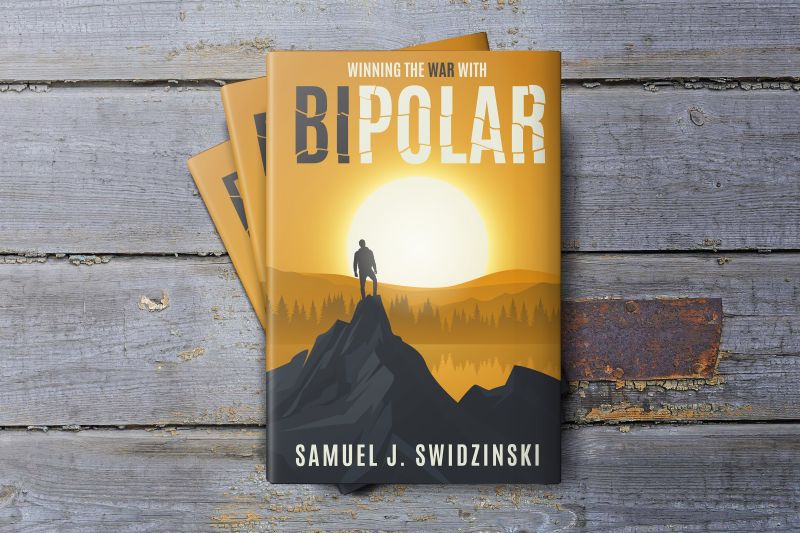
Winning the War with Bipolar (with George Dee, 2020) is the personal companion to the research — for anyone living with bipolar, anyone who loves someone who is, and the professionals who support them.
It says the quiet parts out loud, so that fewer people have to work them out alone.
“I would recommend this both for people with bipolar and those caring for them… As an experienced psychiatrist it gave me a new insight into what it is like to be a patient with bipolar.” Prof Wendy Burn — former President, Royal College of Psychiatrists
“Sam is the author of the masterpiece, ‘Winning the War with Bipolar’ — my favourite mental health book.” Prof Ahmed Hankir — psychiatrist & author
ISBN 9798680138632
06 · Speaking
Talks & workshops
I speak on patient relevance, cognitive-support design, and lived experience as a research method — to academic, clinical, and public audiences.
Making Research Relevant Through Lived Experience (Bipolar Disorder) — Dr Samuel J Swidzinski
- Technische Universität Dresden — “Patient Relevance: The Future of Lived Experience Research” King’s College London × TU Dresden collaboration.
- South London & Maudsley NHS — London Early Intervention Network — “Improving Access to Early Intervention Services” Workshop with Dr Sameer Jauhar — June 2026.
- Mental Health Mission — “Where Art Thou, Affective Psychoses?” With Dr Sameer Jauhar — to EI services across the UK.
- Conference talk, Switzerland — “Affective Disorder Prevalence in First-Episode Psychosis”
- BFX Festival, Bournemouth University — “Environments Building Cognitive Support” Arts and science as a clinical necessity.
- Royal College of Psychiatrists Chaired sessions.
07 · In the media
As seen and heard on
ITV News, May 2024: a piece on what a late bipolar disorder diagnosis takes from a life, with Angela Rayner. I was part of it.
ITV News, May 2024: how late bipolar disorder diagnoses shaped the reporter and Angela Rayner.
- ITV NewsLate bipolar disorder diagnosis, with Angela Rayner · May 2024
- Bipolar UK — Let’s Talk BipolarAuthor of Winning the War with Bipolar & psychological researcher · 2021
- Before You Kill YourselfLived experience & psychological research on bipolar · 2024
- PTSD and BeyondWinning the War Within · 2021
- Stories of Hope — David Susman PhD“I finally feel like I belong somewhere” · interview, 2021
Get in touch
Building something that should measure what matters? Let’s talk.
Open to investment, collaboration, and speaking.